V-Formation
The flight from pilot to production is a visibility problem.
By Kelly Breakstone Roth, Co-Founder & CEO of Prysmic · May 2026 · 5 min read
If you have ever watched a flock of geese fly south, you have seen one of the most efficient communications systems in nature. Twenty birds in a V, no map, no GPS, yet they cover thousands of miles in formation. The science is plainer than the sight: each bird flies just behind and beside the next, riding the vortex off the leader's wingtip, honking continuously to hold the line. They rotate the lead so no single bird burns out. Together they fly seventy percent further than any of them could alone.
What lets it work is total visibility. Every bird sees every other bird. Every adjustment is heard.
This is also, as it turns out, the design problem in front of every team trying to deploy AI agents in production.
The capability question is solved. The deployment question is the entire problem.
Stanford's 2026 AI Index put a number on it. Between March 2025 and March 2026, AI agents jumped from completing 12% of structured computer tasks to 66.3%, within six points of human performance. In the same window, 89% of enterprise agent pilots never reached production.
McKinsey's State of AI Trust 2026 names what is actually breaking. Nearly two-thirds of organizations cite security and risk concerns, not capability gaps, as the top barrier to scaling agentic AI. The line operators should write down: in the age of agents, the worry has shifted from AI saying the wrong thing to AI doing the wrong thing.
A model that hallucinates a sentence is a chatbot problem. A model that hallucinates an action, like filing the wrong dispute, shipping the wrong PO, or emailing the wrong supplier, is an operations problem. Different planet. The blast radius is what makes trust a load-bearing engineering decision.
Gartner's recent agentic-AI research projects that by 2030, half of all agent deployment failures will trace back to insufficient governance and runtime enforcement. By 2028, observability will sit inside half of every enterprise GenAI deployment, up from around 15% today. The institutional money is signaling what every operator already feels: capability is no longer the limiter. Legibility is.
Two layers of legibility
Legibility shows up in two places: in how the agent talks while it works, and in how the agent itself is built and governed.
1. The runtime layer
Every operator we ship narrates its own work, agent name, what it touched, what it saw, why it matters, what happens next, into the surface the team already lives in.
A Logistics Monitor running across active shipments will post: "Packing list missing on SR669." A Freight Auditor will follow: "Quote missing at close on SR643. The right next step is to search our emails and document archive for the agreed quote before escalating externally." And then it does exactly that. Pulls the agreed quote from the supplier email thread, reconciles the invoice against it, posts the variance back into the same channel, files the dispute with the forwarder.
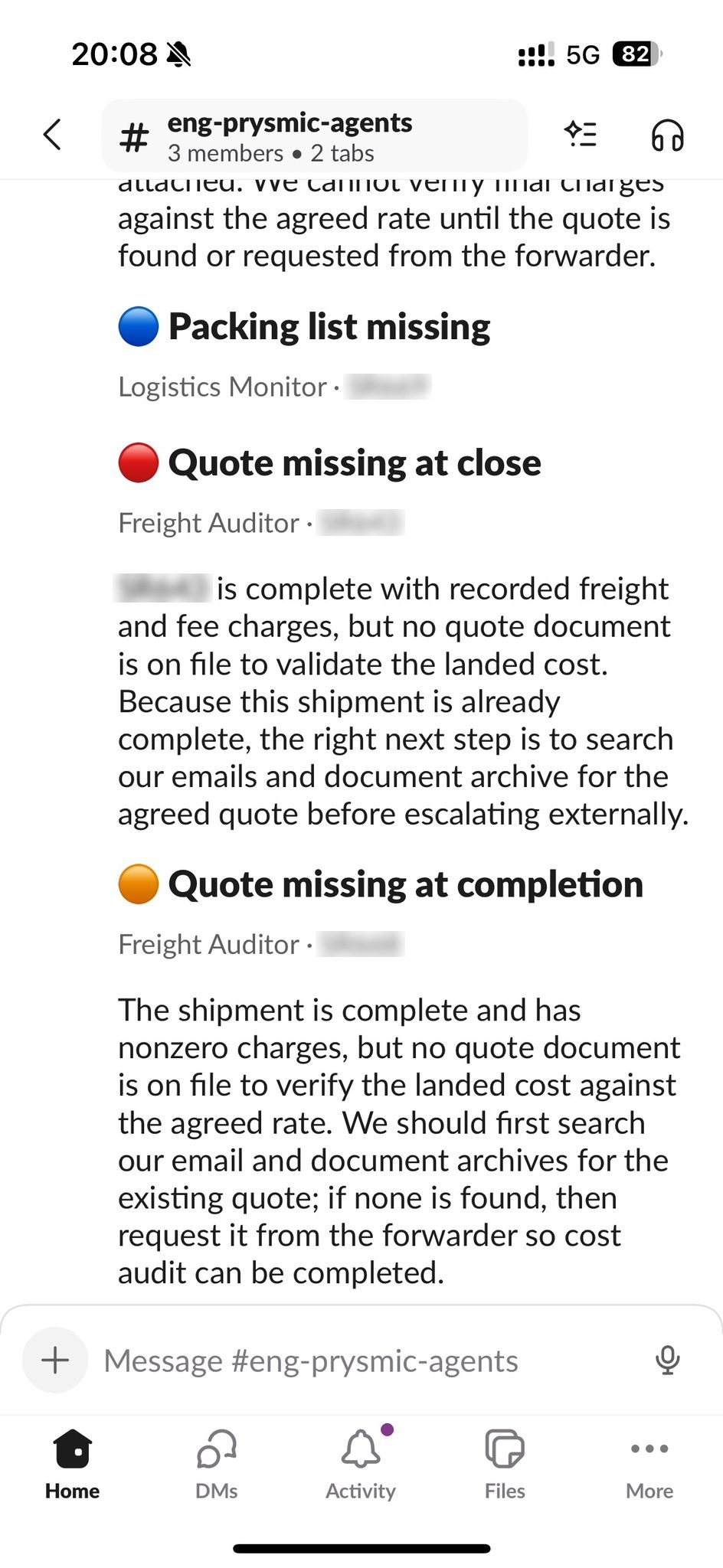
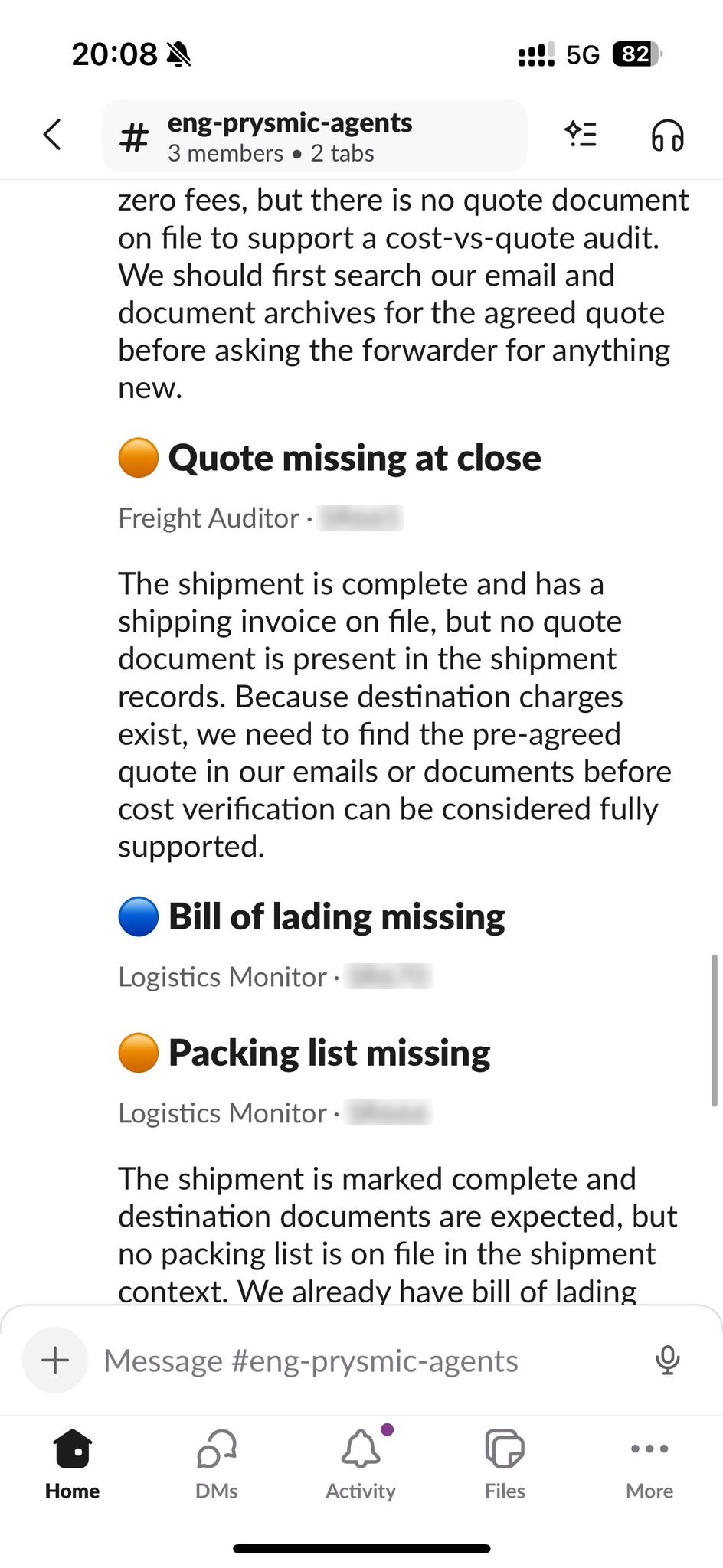
Every operator's signal goes into the channel the team already runs on, the way every honk goes into the air every other goose is hearing. Visibility is built into the work itself, not bolted onto a separate dashboard the team has to remember to open.
2. The workflow layer
The agents that run in production are not opaque scripts buried in someone's repo. They live in a dashboard the team can open and inspect. A Procurement Confirm PO operator running for a customer right now shows up with its review status (Approved), its activation state (Enabled), its full step graph, and a complete run history. Every execution, every input, every duration, every cancellation, every failure, visible side by side with the runs that completed cleanly. Drill into one of its subworkflows and you see exactly what it does, in plain English: Extract PO data from ERP. Validate invoices and shipments exist. Validate status. Compare totals with spreadsheet. If all pass, confirm and process the PO. Only proceed to confirmation if all validations pass.
That is the part that compounds trust over time. A team that can read the agent's narration in Slack on Tuesday morning and inspect the agent's logic in the dashboard on Wednesday afternoon stops treating it like a black box. They start treating it like a colleague whose method is knowable.
What it earns
When agents work this way, failures become instructive instead of catastrophic. A wrong call surfaces with its full reasoning chain, in a place the team is already looking. The first override teaches the agent; the second teaches the workflow. By the time the agent is running autonomously across the team's more sensitive decisions, the team has watched it earn that authority across hundreds of small calls, in plain sight.
There is a thing operators say when we ask what would make them trust an agent enough to put it in production. Almost no one says better accuracy. They say things like, "I want to see what it sees." "I want to know why it did that." "I want to be able to override it before something escalates." Three questions, all the same question, all about legibility.
What that requires, architecturally, is a commitment that has to be made early. Legibility has to be designed into the agent's core loop, not retrofitted later.
An operator built to act first and explain second can be wrapped in a dashboard, but it cannot become a teammate. That is most of what the Stanford 89% is measuring. Trust is being retrofitted onto agents that were never designed to earn it.
Geese evolved transparency instead of hierarchy. The lead bird tires; another takes over; the formation holds because every bird can see and hear the others continuously.
On a smaller scale, that is how AI agents survive contact with operations. Every signal visible. Every shift narrated. The formation, knowable in real time.
That is the difference between an agent that does the work and an agent that earns the right to operate.