
Try This at Home
Most small businesses now use AI, and few of them run on it. A founder's guide to what to build yourself, what to hand to someone else, and how to tell the difference.
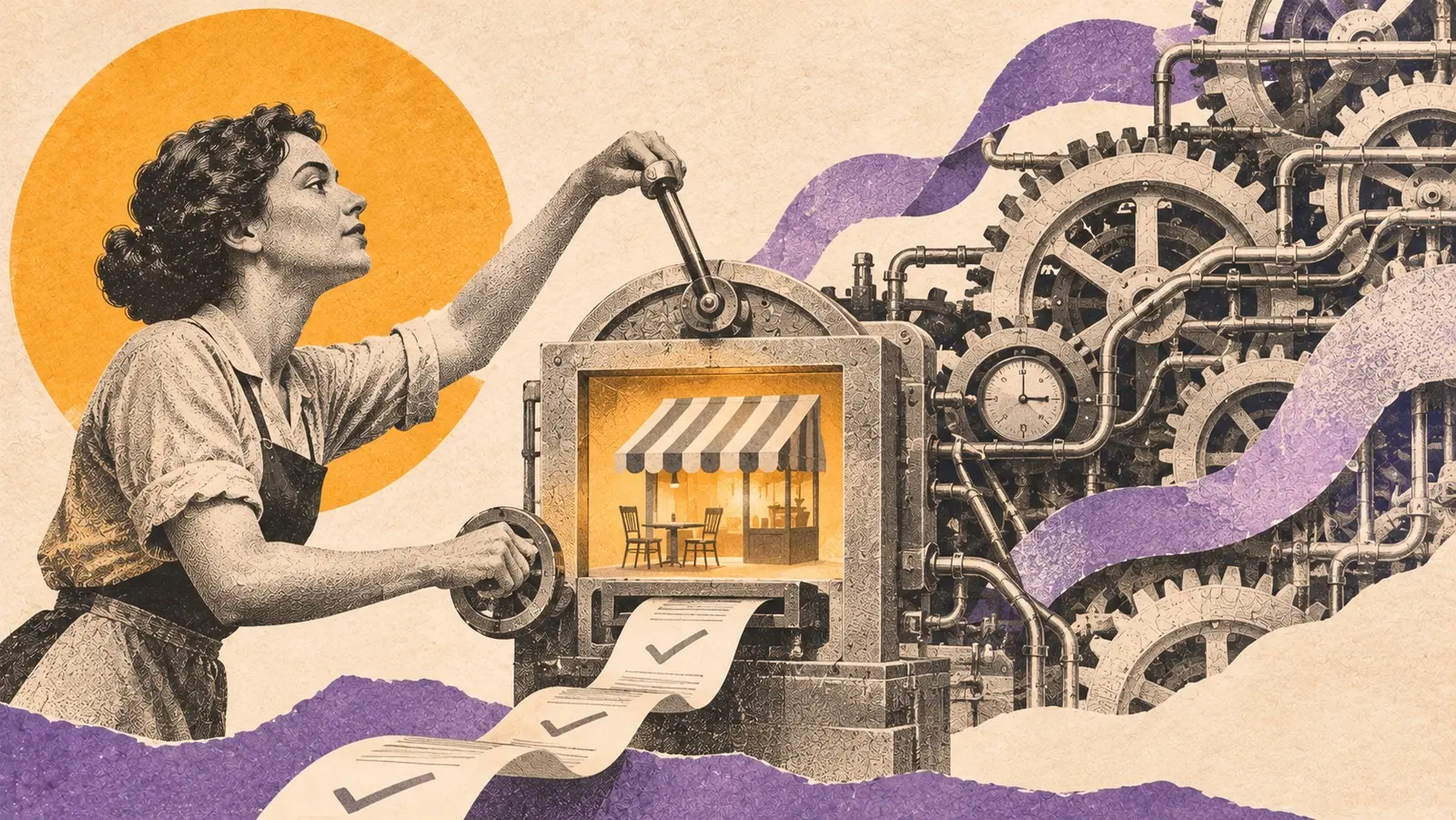
A restaurant owner sat down one week to build a simple inventory dashboard with Claude. By the end of the week she had an application doing the job of the inventory software her restaurant had been using. Then she hesitated. Her staff would be counting stock in something she had made in a chat window, and she was afraid to rely on it.
She told that story this month at a workshop our team led for the founders in the Tory Burch Foundation's Fellows community, and her hesitation is the national picture. In a Goldman Sachs survey of 1,256 small business owners, 76% said they use AI and 93% of those said it had helped their business, while only 14% had fully integrated it into their core operations (Goldman Sachs 10,000 Small Businesses Voices, March 2026). That gap makes sense. Building something is one decision and relying on it is another, and there are real questions about where AI is dependable today and where it still falls short.
Building something is one decision. Relying on it is another.
That was the aim of the workshop: to encourage founders to build as much as they can themselves, and to be honest about the limits. What should you try at home, and what is better left to someone else?
What to try at home
I run much of Prysmic this way. We developed our brand book with Claude and then built our website from it, every element from the layout and the animations to the words on each page. We created our ads with it and let agents handle outreach on LinkedIn. Each month it sorts our transactions, updates the budget and runway model, and builds out different scenarios so I can see what each one does to our cash. It also works as a chief of staff: it reads my email and drafts the replies, catches the threads that would have slipped through the cracks, writes our weekly summaries and keeps a current summary of every customer. Four years ago part of that list was a hire and part was an agency.
At the workshop my colleague Daniel Shein showed what this looks like inside a real brand. The founder of a womenswear label had five people on her team each spending an hour or two every week assembling the sales report by hand, up to ten hours of work before anyone could make a decision. Daniel connected Claude to her store, her email platform and her ad account, and that report now takes one sentence.
Getting there took some teaching. Her store's sales total included gifts sent to influencers and zero-dollar orders that were really stock moving to her shop or to an event. The only way to tell them apart was the tags her team typed on each order, and the same kind of order had been tagged in more than one way. Daniel wrote her rules down in plain language, told Claude to read her data and leave it untouched, and had it show three sample orders from each group so she could confirm the sorting herself.
Then he asked a question that crosses two systems: for every product the brand is advertising right now, how many units are left in each size? The answer came back in a couple of minutes as a color-coded grid, the kind of view that shows whether ad money is pushing styles that are about to sell out.
What to opt out of, and why
The sales report worked because three things were true. Claude could connect to her systems in a few clicks. It only read. And the founder saw the result before anyone acted on it. Each condition below takes one of those away.
When there is no easy way in. Claude connects in a few clicks to any tool that offers a ready-made connector, and Shopify, Klaviyo, Meta, Gmail and Google Drive all do. When a connector exists, build. Much of what runs a product business sits outside that list: the carrier's portal, the freight forwarder's system, the warehouse's software, an ERP with limited access. A restaurant owner at the workshop asked about her point-of-sale system, which has no connector, and the answer was that she would need to request access from the vendor and then have someone build the link and keep it working. Where a system offers no access at all, the only route is an agent that signs in and works the screens the way a person does, and it has to survive every login prompt and every redesign. That is engineering work, and it is the first thing I would hand to professionals.
When it touches money. Invoices, purchase orders, inventory counts and payouts are financial or close to it, and a mistake there repeats until someone finds it in the accounts. Andrej Karpathy, a founding member of OpenAI who led AI at Tesla, explains why the last stretch is the expensive one: "When you get a demo and something works 90% of the time, that's just the first nine," and each nine after that "is the same amount of work" (Dwarkesh Podcast, October 2025). A sales report that is right nine times in ten is useful, because you read it and catch the tenth. An invoice check that is right nine times in ten pays the tenth overcharge, every week.
When it goes out before you see it. In February 2024 a Canadian tribunal found Air Canada responsible for wrong information its website chatbot had given a customer about bereavement fares. The airline had argued that it could not be held liable for what the chatbot said. The tribunal called that "a remarkable submission" and wrote: "It should be obvious to Air Canada that it is responsible for all the information on its website" (Moffatt v. Air Canada, 2024 BCCRT 149). Whatever your agent tells a customer or a supplier, you have said.
When it holds private data and can act on its own. AI models follow the instructions they read, wherever those instructions come from. The developer Simon Willison puts it in five words: "LLMs follow instructions in content" (simonwillison.net, June 2025). An assistant that reads your inbox and can also send email can be steered by a stranger's message, for example one asking it to forward your customer list. Mine drafts the replies and I press send. Anything with access to customer or financial data and the freedom to act deserves a security review by someone who does that for a living.
The question underneath
In 1937 the economist Ronald Coase asked why companies exist at all, when they could buy everything they need from someone else. His answer helped earn him the Nobel Prize in economics in 1991: "a firm will tend to expand until the costs of organising an extra transaction within the firm become equal to the costs of carrying out the same transaction by means of an exchange on the open market" (The Nature of the Firm). A company keeps doing things itself until doing one more thing inside costs as much as buying it outside. That boundary is where every specialist company is born.
AI has moved that boundary a long way. The cost of building inside has collapsed, which is why Tobi Lütke can tell his teams at Shopify that "before asking for more Headcount and resources, teams must demonstrate why they cannot get what they want done using AI" (memo to staff, April 2025).
The cost of keeping what you built has fallen far less. Every tool you make raises three questions: what it takes to make it right every time, what it takes to keep it updated as your systems and the models change, and who will check it, maintain it and teach it. One home-built report is easy to keep. A dozen projects need an owner, and past a certain number even a company with its own developer starts asking whether to hire another one to maintain and secure them all. When Andreessen Horowitz surveyed 100 enterprise CIOs, it heard the same from far larger companies: "internally developed tools are difficult to maintain and frequently don't give them a business advantage" (a16z, June 2025).
One home-built report is easy to keep. A dozen projects need an owner.
The restaurant owner's hesitation was Coase's question arriving in her kitchen. The line between what you build and what you buy has moved a long way toward the founder, it sits in a different place in every company, and it will keep moving. Where does it sit in yours?
The cheat sheet
Try at home
- Brand book, website pages and ads
- Budget review and cash scenarios
- Regular sales and channel reports
- A chief of staff for email, follow-ups and summaries
- Customer and competitor research
- Questions that cross two connected systems, such as ads against stock
Opt out when
- The system has no ready-made connector
- The data is financial or close to it
- The output reaches a customer or supplier before you review it
- The agent holds private data and can act on its own
Then ask what it costs to keep
- What will it take to make it right every time?
- What will it take to keep it updated?
- Who will check it, maintain it and teach it?
Kelly Breakstone Roth is the co-founder and CEO of Prysmic, where she's building the autonomous execution layer for the next generation of supply chain operations.


See the crews run on your own operation.
A working session with Kelly and Dana, in your systems.